Sunday, July 20, 2008

Ab-Use (I would rather not think about) and Waking Up

Utility marks this epoch, utility as opposed to ornament.

In such an epoch, marked by utility above all ornament, we have been confronted by abuse.

Abuse is the abuse of innocence: no where is it more plain than in dealing with the problem of the concentration camps. Abuse gives itself over to the pleasure associated with the will to power solely. This personal will to power manifests itself as the humiliation: the overcoming of all sense (sense: deferring to exteriority) by an internal will to satisfaction.

Sense is deferring to exteriority.

(The purpose of this writing will be to convey a sense that is somehow between any of the concepts that I will explain.)

The word "use" is of recent, almost indefinite origin: that is to say that it does not have a six-thousand year sense of use. Perhaps it might be said that use did not exist linguistico-ontologically prior to 1240 AD (see
http://www.etymonline.com/index.php?search=use&searchmode=none
) . There was "Uti," the Latin root. But this takes us back to the origins of current Latin juridical dominant will to power: that is the epoch that has lasted since the days of the laws of the Republic (508-27 BC) ("checks and balances!").

There are "textual abuses" but the text is always a willing harlot: she is always willing to go there insofar as she is a completely blank space to work upon. But in point of fact the textuality (unless it is a suffocating textile, which is a possibility) cancels the abuse. The question between our capacity to do evil, even to ourselves, depends on our ability to be a willing recipient of the abuse we are promulgating. (This is insufficiently Walserian. And now if I spoke as a cheeky Walserian, I would say something to undermine the sincere, reporting-like quality of the last comment.) Can one murder a truly, genuinely willing victim? (This last statement qualified as "Walserian.") (Notice the placement of notices of verification, a double verification: "truly," and "genuinely," as if this truth must be verified according to the highest juridical standards to be true.) But in point of fact we could point to the will of a person to be a fundamental split: the will of the suicide is the will to be alive, and to literalize the will to annihilate oneself. [This then extends to the responsibility one has to oneself as Other (This last statement was an attempt to catch up with the scholarly conclusions, that in all likelihood Oppermann will have already made; he is about the only reader who will understand all this; it sounds like a scholarly "report" to the academy)]. When Alphonso Lingis, for example, speaks of "abuses" in the line of bodily scarification: he would be advocating the fetishistic, probably perverted, old man line of existence that sees all this sort of thing as just fine, but he unduly scares all the ladies away. Lingis would make a distinction between the profound genocidal tendencies of Spanish and European colonization of the Americas. A large-scale form of abuse for Lingis seems unpalatable, but the ritual scarification of the body: an attempt to transform the flesh into an ornament of the spirit: this can be tolerated.

Nobody is killed in most fetish derived forms of self laceration. A saving point of scarification is that as ornamentation and experience it remains in the realm of mystery and metaphor.

On the other hand, there are pornographic "snuff films" that we can make "scandalous" cinema about ("8mm" being a notable attempt on this ultimately banal topic, banal with the banality of murder and of evil). At this point there comes about an ethical dilemma: that is to say that we have to ask a question of censorship: are there texts that are too vile to be censored? Before I move into an area that even the kindest readers must shut their eyes and shake their heads at, I will move on, somewhat saddened that we live in a world where this thing could even exist. I seem to remember a science fiction novel, other than LeGuinn's "Things" in "The Wind's Twelve Quarters" that depicts an otherwise beneficent civilization that has resolved as a matter of conviction, perhaps one of aesthetic beauty, that the end had finally come and that it was time for human life to extinguish itself. There was at least one other instance of auto-genocide that I can remember. set in the distant future, where each level of society had decided to destroy itself

This would also constitute a form of abuse. We are not at that point of evolution, thank goodness. We still project our ultimate despair on other civilizations and think of ways to annihilate them, I mean what savages we are! I think that I would prefer not to think too much about that.

What wakes me up is that abuse must stop. When I live in a dream for so long: and I see that the dream has become a matter of abuse, then I am forced to wake up. I cannot live with this form of abuse any longer, so, given sufficient pain, we wake up. To wake up means stating that the abuse must stop. This means leaving off: it is an act of gelassenheit that lets or leaves off of a specific text: a text or a snuff film that has become too abusive: the willing whore becomes murdered in Musil's Moosebruger interludes in "The Man Without Qualities."

Abuse happens when one is unable to wake up and leave off: with an outraged cry, with a whimper and a moan: "The abuse must stop." I see the point here that one must only go so far before one leaves off. And that point is easily at the place where the volition of the other fights my own desire to the point that my desire (not my mere survival) is weighed above the life of another. Call me "milktoast" if you will. When surveying the depth of these waters one tends to grow easily terrified, I know I do. And shuddering I tend to just bow my head and to breathe, and then to straighten again. I would recommend, once again, a limit to my own entertainment of such psychopathic material: this is a point of Vipassana: adequate entertainment of a thought back to it's causes and origins. Entertainment does not mean morbid pre-occupation (from there it is an easy step toward abuse). It is a matter of recognizing that there are in fact pieces of the larger personality that can only be integrated slowly.

Waking up is a matter of opening one's heart utterly to the pleroma of yet another new, possibly ontologically different context.

Since I have no time


"Yes, these machines. These machines! They are our friends, they remember lines for us and play them back when you ask: beautiful and incomparable lines, like Gulda himself playing Beethoven. But the machines wind down, they ask for more energy, they test demand of us every last resource. And we feed, and we feed them, lest we find ourselves alone, annihilated, nobody, trembling naked savages in the dark!"
-Juan Apolodoros ("Applications," Book xxiii, Chapter 9, "The Incomplete Aeneid")


Since I have no time, no time to connect, no time to reflect, I will offer you this unthought missive, raw and unhygenic. I will not say "raw, like sewage," because I do not want to spill excrement (after all who would read it?). Yes, after all who would read it? Definitely not Robert Walser, who wonders ahead at things like, "how many words have I yet written of my 500 word essay?" (1000 is too long for him, let me tell you, though often his words go on and on and on and never seem to stop, like some slippery river treading over slime-covered stones, make no mistake about it.)

Since I have no time I will not make comment on any other human genius, so far as the matter can at all be seen by me, I will comment only on myself and my selfishness: what have I done after all, wasted another afternoon? What have I done? I mean I haven't done anything but take stock of the situation.

Bestandsaufnahme: "Taking stock of the situation."

We take inventory of things so they can be stood up on a pyre of usage, usage by our friends the machines: used and burned, in fact burnt out. Used and burnt, yes, or held back in a vault somewhere, glowing, but trembling awaiting use, still in a state of potential, of un-thought, and of dis-use.

Elsewhere I have stated that the process of going into the heart, or stepping out into the world is a process of turning abuse into love.

I can take stock of this, or I can simply live it each waking moment. Ultimately we run into an antinomy: the text is a supplement: it is a form of replacement compulsion, where we write to sublimate the fulfillment of desire: or something else, the text itself is something else, it is an art form we work on and re-visit, from time to time. To write, to practice one's art, in the infernal bibliotech (and I am intending the cold hells of the darkened museum, it's haunted-exhibits in the evening, when no one possibly is there). To write in Hades' repositories of invention, in these "web-logs" or in some other contraption, is a matter of what it means to polish a turn of phrase, or pick a metaphoric leap that is sufficiently bold and unheard of in order to create a dynamism, a quickening of the text.

One thing is certain: I cannot base my action on the text, there is no praxis, except to love again and to forebear from too literal interpretation, it is really the best we can do, and it will once again be another long week full of untold fortune and misfortune. We cannot tell it all, there are not enough libraries in the universe to deal with transforming the victim of abuse into a gentle spirit. How difficult it is indeed for the victims of abuse we see inciting lust! To transform into relationship, where we can actually take a breath and say, you are beautiful as you are, you are beautiful as you are. The abuse stops here. It is enough to say that, it is enough to wake up.

Like the sea shore you are beautiful from a distance: like looking at the unfounded and unfathomable cities of man... from a distance!

Those we choose to unite with: the going will be difficult. All that is left then is presence, breath, and prayer.

Friday, June 6, 2008

And After the Crucifixion

And after the crucifixion
They tell me that the man is risen
That fate or goodness would not let him rest

But after the resurrection is an act of spirit
And before the resurrection is an act of soul

I cannot spend much time
In the urgencies of men
Who seek to assure us that there is one life after this
I keep feeling that the life they are in
Is almost a shallow hell
Made as some sort of trap to put all others in

I am not a pleasure seeker
I am not a man looking for the devil
I assure you that I seek ardently a chaste and decent life
So why do I rest in the bottom of a cry from a man's mouth?

Do I not love women,
Who cry out in agony of childbirth?

So admittedly I would prefer a vowel from one woman straining to give birth
To all the consonants of men?

And yet I will beget no child,
As a matter of principal, I will stand,
Until battered down, just a man,
Speaking to all those other men and women
Who will beget children
And belong to the human race
Swimming in the gene pool
And to those who will not.

There must be something of a commonality between them.
The cry of the man on that lonely wooden tower
We all know how lonely it is
There is no denying
And the lonely cry of a woman giving birth and being a mother
Being something she cannot and will not possibly understand.

The Cry of the Soul


The cry of the soul is simple
It is many things
It is the calling out of lovers in an act of desire
It is the man nailed to the cross expiring

The cry of the soul
...
Well, there is the cry of the soul
That perfect animation
Without any necessity
That is born out
That bares consequence.

So the cry of the soul is parthenogenic
A virgin birth
That is what we ask for,
At least that is what we ask for,

The cry of the soul,
Infinitely lonely
Even the cry of passion
Infinitely searching for something
That was something within a something
Empties out
Without cause into the void

This virgin cry,
So often an animal grunt or scream of exaltation
That cry that comes forth

There are so many poems that enter into discussing the void, and cries and exaltation. These calls are now cliches, that visit us, and can only be propelled by the sardonic turn of experience and insight, at how truly ugly we all are!

Still we believe in the beautiful twilight
Still we believe in the mingling of the clouds and sunlight in the air
The vaguest lines and brief crease caresses
Before the dawn, after the sun has set.

Barber's Adagio For Strings and The Death of Virgil

What is sad, is sad as a refrain,
A refrain that broke out from itself,
As the saddest music of all,
When it broke, adagio,
It carried itself like the broken shards of mirrors
Please know me, know me now
Know that I am broken.

This sadness is not wholely believed in.
It is sadness by the strings of an orchestra
Played by the seriousness of players in the orchestra
Stern, perhaps even stoic faces
Of the string players
Their stone carved stern faces
Become a frieze in a Roman villa,
Well, yes, perhaps,
Yes, and even the Death of Virgil
The strings ride
And the rowing of the trireme
The gathering of sounds
The ocean and the wind

Somewhere, in that absurd decadence
When there was only the presentation of greatness
Not the grim utter eventuality of death camps!
When "man" finally proved, yes, he could be evil
Well, we've known it for a long time
Isn't that the sum of the question?

Below us slaves drive this ship
The Death of Virgil would have us know
That fateful and bitterly sardonic novel
A monument of beauty
By a man who utterly disbelieved in himself!

The slaves drive the ship: the gathering of sound
Comes first through their paddling
It is a first conscious sound
Oars in waves
The stretching of ropes,
Straining against the wind
Baring us into that fateful twilight
Along with the great and dying poet
Already making his voyage to meet Caesar
Corrupt and dejected
Ruler of the fucking world
The saddest man of all
Because he knows he only rules this thing
Such a man is already dead:
He knows his desire is behind him.

Would not Virgil search out some blessed priest or seer?
Or one of those fucking sages?
Why be detained
With the ruler of the world!
Is that the most a man can do?

And there the blessed Poet
We listen with his ears
Hearing the sounds
Before he will go
The sounds we imagine
Before we go.

And the voyage of that final ship will be sealed with the fates and faces of this life
All the images and stories we dared to listen to
Yes and all the images
Will bind and seal our ship
Or it will spring holes
And we will sink to the bottom of the ocean
Let it go
Let the ship clatter and fall into the sea
Let the limping carcass of a great ship
It's dark shape slouching towards Bethlehem
Toward the slumbering shape of perfect innocence
The Christ Child
Before the shape great and terrible evil Beast
Let it go.

(forgive me this terrible poetry, please forgive me
Whoever who might actually read me
With a desire to know me seriously
I know you must laugh and say:
"Ayres is simply at it agian
With his bad cliches
Listening to a CD that his mother thought
Would be good for him to hear.")

So the ship fails
So these arguments
All these presentations
Remonstrations, demonstrations
Will not go, will not hold before death
The greatest orator
Still has words that fall into utter silence!
(The audience, hushed, already dead, as in some Beckettian alternative.)

What is there to do but turn to the breeze
To the butterflies of color?
What is there to do when you turn and face death?

Friday, May 23, 2008

Atardecer: Capitalism and Katalepsy Revisited: Violence and Mercy

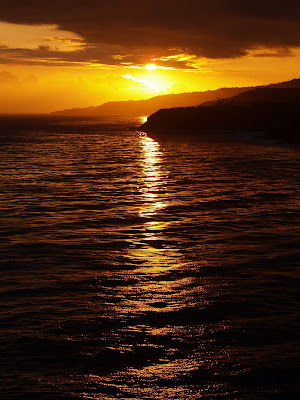
The sunset offered itself freely to me, and the most of its light that I captured, well I offer it to you.

There were no copy rights listed to the sunlight, no sticky black ink of those accounting clerks, with their special sleeves and all those ledgers.

Sunlight thus is offered as "free" at least to those of us who can abide in the sunlight for a moment.

Is there anything we will be able to see or experience that we cannot buy? When we have bought everything and sold everything: not only with the marketplace: we will have sold ourselves into slavery. That is the real threat. So when speaking of what is "free": well we think that the air is free, and we will deny it to no prisoner. We will not deny air to a prisoner. Sometimes we let the prisoners go anywhere and hang themselves there. In that case they have denied the freedom of air to themselves, of their own free choice. (In a world where public hanging by the state is not generally condoned.)

So we could say that we are waiting for the last dog to be hung in capitalism: waiting for the moment when we say: "No not even the air is free." The problem with Capital thereby is its infectious quality: it is the greatest contagion we have ever known existed. No sooner have we had experience than we seek to commodify it.

Now we know that we exist and thrive on a planet with other beings who/which make it possible for us to live. (These other beings are a "which" only insofar as their reality is not ontic, belonging to the realm of every day life, the life that Capital seeks to conserve upon every object it comes in contact with.) The inter-relation with these other beings necessitates that we exact some price of living when we set them aside: when we cut down all the forests that make it possible for us to have the air we breathe. The effect of the insane expansion of the human race, six to seven billion and counting counts as a cost to the very air we breathe. The ecologists, not the economists, are the first ones to tally the cost.

Now there is to imagination the possibility of meditative insight: that insight that remains sufficiently in the present, and does not seek to do anything with this experience (no, not even write about it). Meditative insight constantly seeks to return to the present, and to the breath, which is life, which is "free," isn't it?

There is plenty of time, means that we do not have any specific need to immediately and literally act: we are not abandoning insight to fate (Geschick). In other words, there is room to breathe.

Room to breathe can be contrasted with the rhythm of the breath seen in Oppermann's essay on Anaximander. Rhythm implies something of this action that is enclosed in itself: it repeats. It is the repetition of the same. We all know that reality is changing: this is the Heraclitean fire meditation.

Time exists, and not just time as consumption, but as the pre-existence of leisure before necessity: time exists as a sense of distance to the horizon. There is no time on the horizon itself, the time is up.

We could say that the sunset is not free. We could say that really it is worth sacrificing just a little bit of life to this sunset. That the time spent in contemplation of such a wonder: well it is spent and consumed: but we are spending life now, principally our own, and not just money. Life's expenditure is time, and implies the wearing and weathering of time: what was familiar becomes patina'd in the corrosive elemental elixir: and this temporalizing is the source of the most profound beauty, not just sentimentality: an exquisite suffering that Robert Walser attributes to the essence of music: the most beautiful passing of time.

By contrast to the exquisite suffering of the burning love-making of time, money lives in instantaneous transaction: ownership passes over instantaneously, though it be ownership at first without soul, such ownership determines destiny in an instant. The effect of money is instantaneous and is not affected by time.

Admittedly money can mature and devalue through its contamination by being related to a history, a sense, a nation etc.. Who in the world does not know that the "almighty dollar" does not buy in the world what it used to! You cannot sleep a night for a dollar anywhere but the poorest or most sanctified spiritual establishments: everything costs rent, costs money and the rent keeps going up and up, we acknowledge to deal with the problem of inflation.

So we know that money inflates. Money inflates: the coin of Rome, I think the Denarius went from being worth a week's worth to being worth virtually nothing. The historical account in Wikipedia runs:

"The denarius was first struck in or about 211 BC during the Roman Republic and at the same time as the Second Punic War, with a weight of 4.5 grams on average at the time. It remained at this weight for a while and then decreased to about 3.9 grams during the second century BC (a theoretical weight of 1/84 of a Roman pound). It then remained at almost this weight until the time of Nero, when it was reduced to 1/96 of a pound, or 3.4 grams. Debasement of the silver began under Nero. Later Roman emperors reduced it to a weight of 3 grams around the late 3rd century [1]. The value at its introduction was 10 asses, giving the denarius its name which translates to "containing ten". In about 141 BC it was re-tariffed at 16 asses, to reflect the decrease in weight of the as. The denarius continued to be the main coin of the empire until it was replaced by the antoninianus in the middle of the 3rd century. The last issuance for this coin seems to be bronze coins issued by Aurelian between 270 and 275 AD, and in the first years of the reign of Diocletian. For more details, see the article 'Denarius' in A Dictionary of Ancient Roman Coins by John R. Melville-Jones (1990). [2] [3]"

The "As" (originated in 280 BC during the Roman Republic) is a coin with an image of Janus: a two faced Mercurius. Mercurius was the original god of the marketplace, if I need to become didactic. But Mercurius himself, a divine force was worn out by the time we came to the Denarius. We can from this take that the Denarius, the 10: is an amplification, the introduction of the 10th Item in a base ten system (prior to the invention of "0"): x.

Ten for the Romans, was a cross, an intersection. Only with the invention of Zero did (and "0" is in some manners the very sum of invention: the shift from non-zero based counting to zero based counting may be the paradigm of "invention" in our culture: a place holder, and nothing more.)

The highest coin of the Roman Empire was the Aureus, valued at 25 Denarii. It was issued in the 1st Century AD, before the Empire became Christianized. In large the Aureus probably came about as the first Roman theological response to Christianity. The Denarius was invented around 210 BC in the time of the Roman Republic. Two hundred and fifty years later, Nero was busy in his George Bush way depleting the Denarii to nothingness during his lifetime (Nero Claudius Caesar Augustus Germanicus (December 15, 37 – June 9, 68), also pleasantly placed after the birth of Christ (some referred to him as the Beast, 666). But enough of this Apocalyptic mumbo jumbo. We can still say that we venerate Gold for it's immutability: it can be placed on things like excrement, but it itself remains golden.

Gold brought into currency in our epoch, in part because of the rise of Christianity, which would be the most significant spiritual movement, based itself upon the Eastern Religions: Christ is essentially an oriental divinity (read: Chinese) placed on the template of barbaric western polytheistic culture. One could say, well, barbaric as opposed to what? Is not one dream as good as another?

When we get to this spirit, who rose with the dawn, this spirit was breath, and the spirit was free.

Jung (lest we forget him) has something to say as well about the "denarius," however he intends it to be about an alchemical image, not about some damn Roman theurgical-necromantic coin. I however am interested in the coin only because it is of less and less value, such is the coin's unhappy fate. (There are numismatic societies who fetishize ancient and de-circulated currencies. These currencies are themselves capitalized upon, based on the exacting mapping of desire according to rarity or uniqueness of a given currency or currency error). The Jungian denarius means nothing about money, but we must cite the man if only to be somehow frustrated in some sense by who he is and what he has to say:

"The denarius forms the totius operis summa, the culminating point of the work beyond which it is impossible to go except by means of the multiplicatio. For although the denarius represents a higher stage of unity, it is also a multiple of 1 and can therefore be multiplied to infinity in the ratio of 10, 100, 1000, 10,000, etc., just as the mystical body of the Church is composed of an indefinitely large number of believers and is capable of multiplying that number without limit. Hence the Rebis is described as the cibus sempiternus (everlasting food), lumen indeficiens, and so forth; hence also the assumption of the tincture replenishes itself and the work need only be completed once for all time. But, since the multiplicatio is only an attribute of the denarius, 100 is no different and no better than 10." ("The Practice of Psychotherapy": "Psychology and the Transference; paragraph 526)

What may irritate me the most is that the Church as a further multiplication becomes simply a multiplication of a single breath: and it is an admission that each breath is finite. The question remains as to whether each breath remains singular. The question would be whether we have to acknowledge that the universe is not infinitely creative, as Nietzsche hints at in "The Will to Power." Infinite creativity would be a creed, an escape hatch, a breath of fresh air: otherwise the breath will remain the same, and then we really will be caught, doomed and defeated to becoming nothing but the same. This really would be hell, because the world hangs in such a balance: it is the tormenting of tormenting. What makes us "hang in there" (and not in a holding pattern, or hung as the last dog will be hung at the final accomplishment of capital commodification of the air we breathe) is our hope to bring a fragment of kindness, the smallest sliver of faith, love or grace into this tormented world.

I could lie, but this picture is an image of the dusk. This is an image from the West Coast of America. We have continually asked our sons, our European sons to "Go West." Some of us have really got there, and we are sitting laughing, saying, don't you know that the earth is round? But the citizens who live on the next ledge of the world: well they have already got their own idea of how to live, and we cannot really invade their lands now, can we? Isn't it interesting to think that America was bought by European conquest at the cost of the inhabitant's blood? But isn't it interesting to note what will we do? What is the Shicksal of our Western Civilization if we do not turn West again?

Well we can say that modern technology and capitalism is born of the libidinal filling of the gap: of being able to turn and invade another any more: primitivism and our own lack of resources kept us from turning this into one planet. And we may be thankful that we did not have any further to go, that there was no more land, that the ocean between us could not be bridged. It gave everyone time to catch up.

Now Japan may essentially be becoming one big suburb: a kind of vestigial result of imperialism embedded within capitalism (again, noting how coins are issued principally, at first to... armies.)

There was one imagined destiny that never was met. This was the destiny of the very first explorers: that somehow they would never cease from their exploration: that somehow they would keep encountering "benign tribe after benign tribe," keep assigning them to the empire, until they somehow met with themselves. What would in fact happen that one fateful day when Cesar's armies marched from Rome all the way round the earth to conquer... ROME? We have not lived this possible but unlived future, and this unlived future may be a very important counter-dream compared with the hand we were in fact dealt.

In point of fact the natives were never very pleased to see us. There were no benign tribe after tribe. In point of fact they had pointy spears and arrows, lots of barbs. Why the hell should we be let in? So that we could give them all three televisions and a family car, and maybe a sofa? So we could give them a wife and three kids? So we could give them computers and Web logging screens, I mean WHAT NONSENSE!

They wanted their ways, and the ways that belonged to them. The degree to which we, we of the empire of coinage, disaffected them, and I mean all of them, to their own ways is the degree to which we can experience their addiction in and to and through current popular culture.

Who holds these brief images?
Who holds this torrent of words?
Like the torrent of hard rain
Sung by the poet singer, Bob Dylan

There the sun set on the West Coast
The Pacific wall of the Western dream
The sun according to this dream is still free
Because it lies across the empty dreaminess of waves

The last attempt that Cesar made
To march off in conquest of Rome
Has been thwarted
As a horrible perversion and catastrophe of itself

So now the dream turns back on itself
Turning and turning away from any direct line of conquest
And now the son from the East
The Son driven West has no where left to go.

Oh well, the Myth can go onwards and upwards
We can conquer the mountains of the moon
For a million dollars a day we could send someone up there.
Money is getting devaluated.

American capital did not really have that much to do with the Devaluation of the Denarius, no. Rome fell and Christianity permeated out like some holy mist (could be swamp gas?), blowing dust and smoke billowing out from the collapse of Roman edifices.

America, the dream of America, Nero, devaluator, America is just another acknowledged empire, and the World turns its back on us, and the value of the Dollar goes down, and we think, oh well trade protectionism at work there! There is no need for all those Japanese motor cars and TV's that we told them how to make. We can sell our goods to them cheaper, and more dollars we will make. So much for importing any more ideas. The ideas as the living element of Capital now will begin to cost too much.

But did anyone Object to Rome so much? Did they object to Rome in the manner that we object to the United States? Rome was a theurgical-political construct: part born of Western "gods" and part of the excrescence of Death: another one of our gods: who translated himself into money. America has become one and the same empire, perhaps it is objectionable because it began with the principles of the so called "Enlightenment": promising "Life, Liberty, and the pursuit of ...Property to every man: that there should be no more slaves. But we have already stated we are slaves to our money: to the epidemic of commodification. The United States promised some life that we might live beyond the dominion of kings and slum lords alike: it promised us the beauty and enlightenment of light (see image of sunset inserted above). That damn sunset was free anyway, free as though I could give my life to it and it could give it's life to me.

In the face of this epidemic, where we ourselves are moribund, contaminated with capital through and through, our option is to write as dying men, still pointing to the red felt stamped with gold that forms an outer protection to our scrolls. We can still point to our "Ateliers": we are the stricken men in a plague: the horrified prince, struck down at the end of Edgar Allen Poe's Masque of the Red Death. -This is what it means to live as an intellectual in the eschaton of capital (!) ... the endless eschaton of capital, the essence of a "bad infinity." Money is the condemnation of the soul to death.

Katalepsy, now who really wants that? It's a disease, and we have doctors invented to keep us from going insane, becoming "cataleptic." I have begun to suggest that the only "salvation" I find in this life is when something seizes me, when something breaks in: it could be my guilt and it could be my rage. At these moments, at one with the current of violence in the universe, I am aware that this Being is neither Good nor Evil, it is closest akin to whatever energy sets me aside from me.

The quest for "objectivity" of the true man of science: is the quest for that which is "Beyond Good and Evil." Two great characterizations of this sacred "Objectivity" were Thomas Mann's "Settembrini" in "The Magic Mountain," and Nietzsche's character of himself, "The Antichrist."

My friend once was called "the epileptic," a sister, a kissing cousin really: she said that to become "epileptic" was the feeling of being raped by the Devil: I find this akin to Katalepsy: being merged with the current of violence in the universe.

A digression into the current music: Robert Johnson: my sense is that though he supposedly sold his soul to the devil, that is, the current of unaccountable violence in this world: my sense is that he still asks for a pittance of mercy and kindness: his music has taken on the figure of a intransigent blown this way and that by that free air we breathe. Now it is a curse that is said when we say of someone that "they will inherit the wind." As if all their value will become Hades dust and blown away, but I see that Robert Johnson still begs for the current of Mercy that also works its way through the universe through the ache of our hearts at the sound of true music and at the rise of dawn and the fall of the sun.

But once again, with violence there is no room to breathe, and the threat with catalepsy is that held in the essential violence of being: held in its grasp we will not be able to escape. I say that beyond Katalepsy there must still be room to breathe. The breath will become finite, once again, re-duplicated, in other words, breath's focus and force will diminish in it's re-duplication: each repetition will somehow make the first breath just one of many. The first breath was the ultimate miracle of life: it's negative, counterpart from death, is found in the "invention" of Zero. "0:" a number that by itself adds nothing to the condition. But the Zero, an Arab invention, is not itself inherently evil. It is an extremely powerful abstraction, a deterritorialization of "counting" into a form of intensity that we use everywhere and every day. Zero, and the violence of the universe? A zero is an act of violence insofar as it is a "deterritorialization": some Gestell is ripped up and reframed: counting itself becomes counted: the zero accomplishes just this.

What is counted anyway? Ultimately lots of items: there is always behind this an operation of counting tithes, or tribes, the numbering of ships, or the numbering of the tribes of Israel: number of heads in a gang: where number is relative quantitative power of one versus another assortment of heads. Counting implies that the quantities are countable: that's what we have computers for: exquisite loads of counting in order to frame and represent. Now that the immense calculations are provided for us by these machines, we continue to exist in an aether of ideas: we continue the struggle of life for compassion, to be free, to breathe one single free breath in gratitude... and commodification of the very air we breathe, suffocation and death.

Now I am a humble man, and, to be honest, I ask for a pittance of grace and charity in the face of the immense cruelty of the world. I cannot think of myself as asking for anything other than from the lap of charity and kindness. And I want to ask how far, how far does one really have to go?

But what saves me sets me aside from myself. What saves this whole predicament, this "waking-dream-predicament" is to deal with the current of violence once again.

We keep saying that the "Good" is pre-ontological: in other words we pray that what is at the center of the universe, the heart of everything we experience is goodness. Beyond any experience of its profound indifference. But what if this violence were pre-ontological?

We all know about the violence of the despot: the one who set out to conquer the world and set it into order: one word, one realm, one currency, one language, ordered and controlled, regulated nation under "God." We know that the despot always hides the violence in the mystical foundations of the state.

I still, defiantly, ask... no, my friend, I am down on my stomach, prostrate, I pray for a share of compassion and mercy, like that final light that pours in rays through the sunset. I know that the dream will go on and on, it never stops for anyone or rests for a single moment: like a vapor of smoke heading West it rebounds and goes on its way: up of back towards the East. What I ask for is not offered to me from above: but rather is offered when the sun itself sinks nearly to my own level: that is my poor perception, yes, I know, here on Planet Earth, but that is what I believe, when I turn and face the sun, and I am on one level with this being of great light, facing the eternal violence hidden within a path of stars, praying for a shred of mercy in all this torrent of grief and light.

Friday, May 9, 2008

The Ocean, Techne, The Presenting of Consciousness, the problem of Death (13), and the Gathering of Logos

This is more of a purist look at the ocean. I have hurried to this image: the 14th image, because superstitiously I did not want to leave this web-log on the 13th image. 13 is the number of death in the Tarot, among other things. 14 has its difficulties, two sevens, and so on, but seems an even number. 13 in Christian iconography is the number of betrayal: Judas the betrayer. It is no small coincidence that 13 is also the number of "La Eme," the Mexican mafia, who's name, like the name of the Devil ("speak of the devil") in ancient times could not be uttered without fear of drawing forth its terrible literal presence.


In point of fact, between the devil and the deep blue sea (at least as blue as the sea pictured here), one could say that the most ancient form of magic is the simple connection of voice and manifestation: speaking of the devil still sends superstitious shivers down my own spine in the age of technological enlightenment.


Still, which is the thirteenth web-log? Could it come before or after the literally placed thirteenth web log? Is such a web log radically futural? Could it be that numerical value has little, if anything, to do with the actual thirteenth web log?


This image, like the previous two deals with water: there are fragments of shoreline, but essentially we have a kind of Rothko blue painting:


Image courtesy of another web log (!): http://nathanabels.blogspot.com/2008/01/blue-monday.html (I will disavow any direct relation to pseudo-pop-psychological speculations on the blueness of monday, except I believe that "The Beach" was the "B-side" of the New Order single "Blue Monday." I think that the image at top was actually taken on a Tuesday: its folder bears the date 5/6/2008


Rothko's mondays or paintings, or whatever you will, still seem to be too saturated, possibly with his alcohol or depression, or literalism (suicide is taking the death instinct literally: Rothko, dead at age 66 on February 25, 1979, from an overdose of antidepressants, slit wrists in the studio sink, what a fucking pity, what a horrible pity!). I really have always liked this form of abstract art, contrary to friends who cannot fathom why I would take an interest.


My own image of the ocean, in contrast to Rothko's painting, if you can call it "mine"-- since it is a temporary framing of a natural event, which itself charges no fee for the electrons reflected and diffused from the various surfaces to be transformed into an electronic matrix.... My own image is a single sheet of blue: not a blue dividing blue from blue: there is just enough of the sky left to mark a division of heaven and earth: in a sense the Rothko painting presents a balance: the waters of the unconscious are balanced and clearly demarcated from the image at the top. My own blue ocean photograph carries a single blue abstract intensity of the ocean, the fragments of stones: black clear cardiographs of rocks, the curl of a wave, the sun at this morning hour is presented in reflection, or perhaps diffused through clouds on the wave....


I suddenly have a fantasy about an alien civilization that essentially is blind coming to visit us. They would look at our culture, understand electricity and so forth. But the ability to understand anything of our civilization takes this photo-electric phenomenon called light sensitive eyes. We should include that all instrumentation, and mediation should include the eye apparatus: and instrumentation such as computers relies on this heavily at this time: there may be a future where it will not have to rely so heavily on our "far seeing" capacity of ocularization of consciousness/techne:


(The beautiful Roman Oculus: The Pantheon used the retina of light to express consciousness reaching in: casting the true light on the nodding numen of the statues...) Source: http://www.usu.edu/markdamen/1320Hist&Civ/slides/05space/oculus.jpg


It follows that we have the following drift of the ocean of consciousness: or, conversely, the casting of light on the following complexes:

  1. The presenting of the ocean itself, flat blue, moving to horizon

  2. The initial digression: number 13, the number of betrayal.

  3. The issue of "speaking of the devil" literal presenting: probably the technological question in a nutshell.

  4. The issue of the power of speech in magic as the presenting of the object: the essence of technological attainment: invocation = manifestation.

  5. Instantaneous gratification of libidinal drives (Freud).

  6. However: the number 13: Is betrayal: the "speaking of the devil" the very essence of technology: some kind of demon or djinn appears who's power is appalling: who clearly means to kill the summoner.

  7. Jung's telling of the story of the wood cutter (Holzfeller!) who finds the Spiritus Mercurius in a bottle under a tree: burried there for 500 years or so: the woodcutter listens to the little black frog in the bottle who cries in a tiny voice: "Let me out! I will give you your reward!" When the Holzfeller actually lets the spirit out of the bottle: it grows to an enormous size and threatens to devour the man, saying, "This is your reward!" the man however says "If you are so smart there is no way you could have come from or could return to that bottle, prove it to me!" Whereupon the spirit actually does return to the bottle, the Holzfeller returns the cork and then bargains for a better deal. (Smart Holzfeller!)

  8. The exhaustion of the digression into number, representing and presenting

  9. Rothko (who at least has an interesting name) and abstract art: which never "speaks of the devil"--- at best it can only speak of itself: "I see brush strokes and blue paint on a canvas in squares..." and so on...

  10. further digression into the topic (or non-topic of "blue monday" presented in another web log as the frame for the Rothko painting: in point of fact because Rothko was pretty depressed Blue-ness itself would be appropriate to speak of him in this manner.)

  11. Final Digression into the symbolism of the eye: the oculus: as counterpoint to the image of the ocean: the light of the eye penetrates into the pantheon of shapes: the ocean receives:

  12. A pure abstract modern work of art: a representation of an ocean that is not an ocean: the fine granulation of rocks and stones: the intensity of the blooming blueness that does not make this representation but act of music, dancing, energetic brilliance, that is all:

  13. Neither the penetration of the oculus, technology nor the passivity of the ocean as ocean, but some substance, perhaps pure horizon, that stretches out with potentiality in between

  14. All of us know that we live and work on a sphere, and that however illimitable we see the horizon in our abstract work the sphere works to finitize the ammount of matter and resources we have: once again curvature has to do with sein-zum-tode.

  15. The relation between the turning points: ocean to life, life to consciousness, consciousness to self consciousness, self-consciousness back to ocean once again... and so on: self-consciousness to consciousness, consciousness to life.

  16. The techne of the pantheon is the gathering of the light into a light beam. The techne of a photograph is the gathering of a landscape into and through itself back to consciousness: the techne is in the lens: since we cannot point to the earlier artifice of the temple: we point to the fact that representation has become so fine that it can now turn to a more subtle contemplation of "nature" as presented through the "ocean" of this photograph: the condition of a space apparently devoid of techne (but through the techne of the photograph!), as opposed to the Pantheon which could only "naturally" present techne of the psychological complexes gathered under one roof, under one all seeing eye of the sun.

  17. And so on.

  18. And yet remains the question of 13 in the Freudian sense of Thanatos in "Civilization and its Discontents": the silent aspect of death, if life is boisterous and noisy enough: the retreat of Being in Heidegger's language: an absenting in the midst of the boisterous technological presenting of all that is present. A-ides, the unseen and, for the Greeks, unspeakable one.